
Today’s article is on the “NRI Income Tax Filing Checklist“—a topic of growing importance as global mobility continues to rise.
For Non-Resident Indians, navigating India’s tax regulations can be both complex and crucial. This article will guide you through the essential steps and documentation needed on NRI Income Tax Filing Checklist, accurately and efficiently from abroad. So we thought of developing a NRI income tax filling checklist. This is update for FY 2025-26 or AY 2024-25 filing of income tax.
We’ll decode residential status, income categorization, exemptions, and required disclosures, ensuring compliance while optimizing tax benefits. Whether you’re a first-time filer or a seasoned investor, this NRI Income Tax Filing Checklist will empower you with clarity, confidence, and control over your financial obligations in India. So let’s get started!
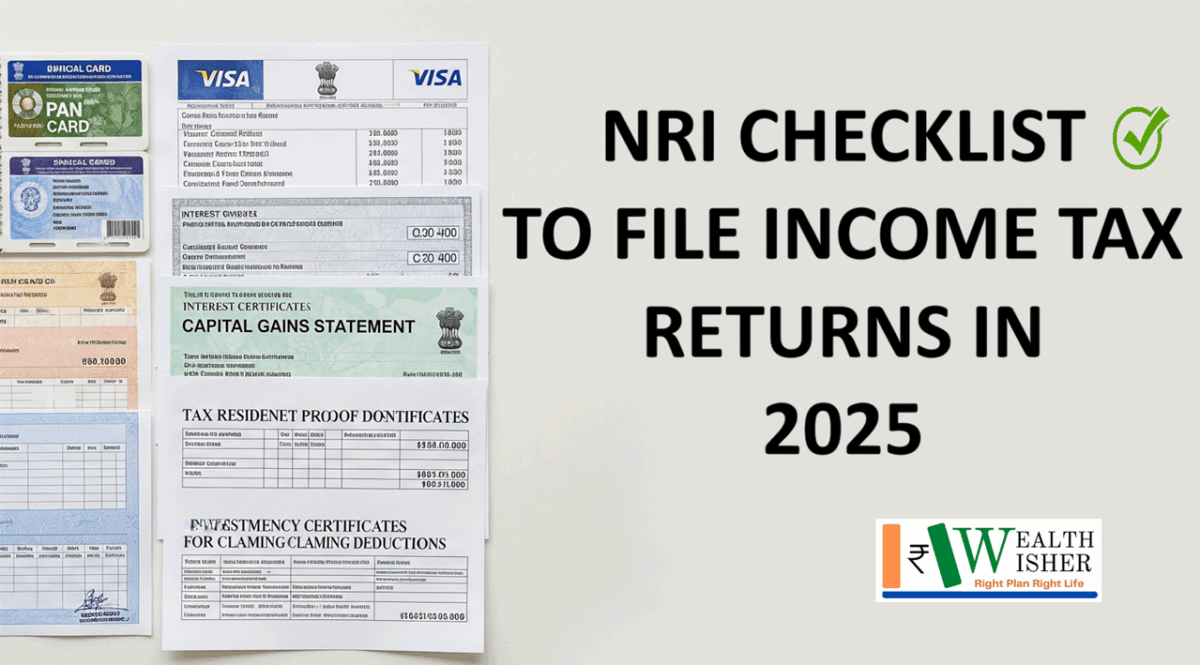
Here’s a comprehensive checklist of documents, “NRI Income Tax Filing Checklist,” to help you stay compliant and avoid common errors:
NRI Income Tax Filing Checklist for FY 2024-25
Essential Documents to Collect 
- PAN card
- Valid visa or overseas residency proof
- Bank statements (NRE, NRO, and savings accounts: Apr 2024–Mar 2025)
- Interest certificates (especially for NRO account)
- Capital gains statements and dividend income reports
- Investment proofs for deductions (e.g., under Sections 80C, 80D, 80G)
- Tax Residency Certificate (TRC) and Form 10F (for DTAA benefits)
- Form 16 (if salaried)
Income Reporting Guidelines
- Report NRE and FCNR interest income (even though tax-exempt)
- Use ITR-2 (ITR-1 not applicable to NRIs)
- Disclose dividend income (taxed @ 20% under Section 115A unless DTAA benefits apply)
- Include all Indian-source income even if TDS already deducted
Technical & Compliance To-Dos
- Link Aadhaar with PAN
- Validate bank account on the Income Tax portal
- Update mobile number and email ID on the portal (must be current)
- Ensure residential status is correctly determined
- Less than 182 days in India during FY
- AND less than 60 days in FY if stay in the previous 4 FYs is under 365 days
- Understand “Deemed Residency” rules
- Indian citizens earning over ₹15 lakh in India and not taxed elsewhere = RNOR
Common Pitfalls to Avoid
- Not reporting Indian income with TDS
- Ignoring discrepancies in AIS (Annual Information Statement) or TIS (Taxpayer Information Summary)
- Omitting details of Indian assets or liabilities if total income exceeds ₹1 crore
- Using outdated contact details on the income tax portal
Filing income tax in India is crucial for NRIs—not just for compliance, but for financial clarity and long-term benefits. If your Indian income exceeds ₹2.5 lakh in a financial year, you’re legally required to file an ITR—even if you’re living abroad.
A filed ITR serves as official proof for repatriation, visa applications, or securing loans.
There are TDS on NRO interest, rent, or capital gains is often higher than your actual tax liability. Filing lets you claim refunds and avoid excess tax outflow. You can only carry forward capital losses if you file before the due date.
Non-filing can trigger notices, penalties, or scrutiny from the Income Tax Department. Filing helps establish your non-resident status, shielding you from future tax complications or misclassification.
This checklist on NRI Income Tax Filing Checklist in 2025, should keep you well ahead of the curve.


